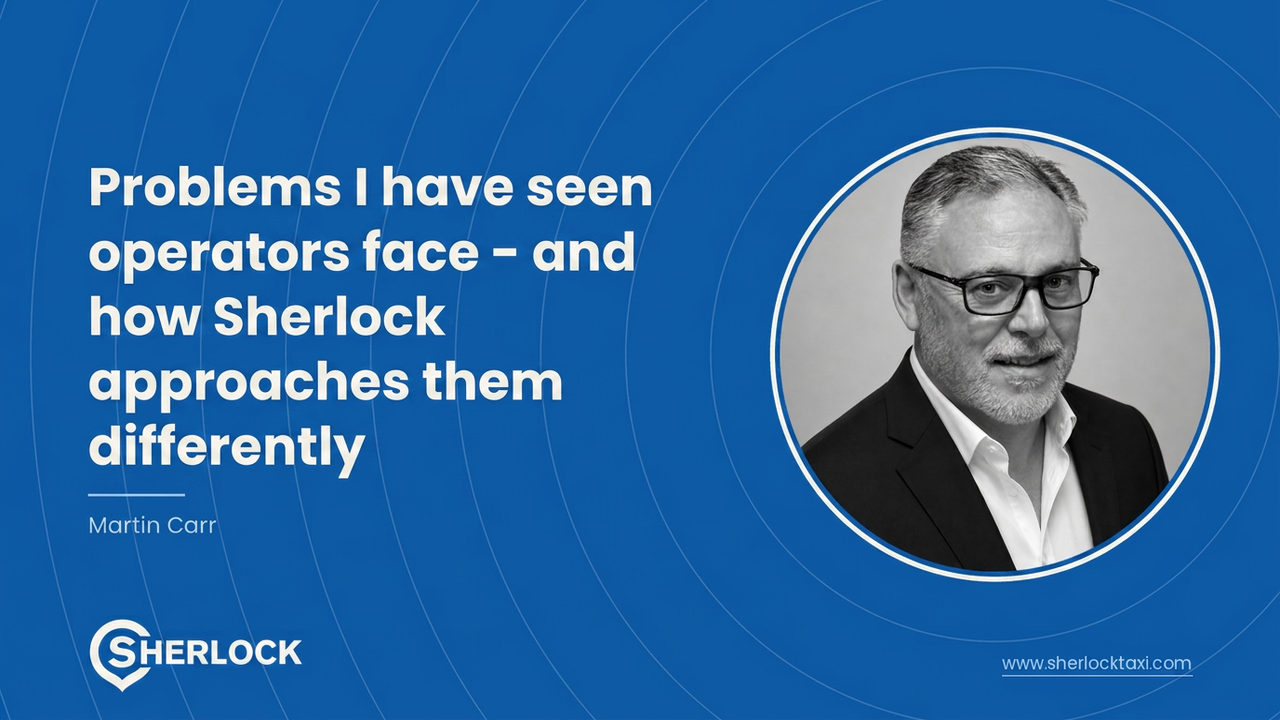
Honest observations from a new member of the Sherlock team.
For those of you who don't know me, my name is Martin Carr and I have more than 25 years’ experience in the taxi and private hire industry, including working extensively with a range of operators using different dispatch systems. I joined Sherlock Taxi as a Sales Manager in June and I've got lots of thoughts on my short time with the business so far.
I spent my first couple of weeks meeting the team – getting to know Account Managers, Marketing, Technical Leads, Project Managers and Support. Through spending time with the different departments, I started to get to grips with the role everyone has in the business, who is responsible for what and how Project Managers work alongside Support to assist customers.
One of the things I noticed immediately is the longevity of the team. Most staff have worked at Sherlock for several years – testament to both the company being a good place to work and how knowledgeable everybody is about the product and what customers are trying to achieve with their technology, as a result of so much experience.
I could see this knowledge immediately; whenever I asked why the system behaved a certain way, there was always someone who could explain not only how it worked, but why it had been built that way—usually because of a real problem encountered by an operator, rather than a feature developed by tech people that don’t understand the operational context.
I've also had the chance to learn a lot more about the history of Sherlock. For those who don't know, it is developed by Haulmont Technology, the developers behind Addison Lee's proprietary software.
Haulmont built Addison Lee's system in the 2000s, at a time when most dispatch operations still relied heavily on manual decision-making, therefore making the auto-allocator a true first in the industry. Learning how the platform evolved from the real operational problem of dispatching large volumes of trips simultaneously - rather than being built purely from a tech perspective - shows how Sherlock is shaped as a tool that solves actual problems for the wider market.
As I have started to attend more client meetings and onboarding sessions, I've seen Sherlock in action. The biggest surprise has been just how configurable Sherlock is. Most systems boast long feature lists, but I have rarely seen any that can be tailored to individual operator needs as much as Sherlock can be. Additionally, I've noticed that if an operator does want something specific for their business, Sherlock is one of the few providers that can actually take a brief and build something bespoke for a client.
I've spoken with several Sherlock customers, ranging from start-ups to big multinationals and it is evident that they really benefit from just how flexible Sherlock is. At the same time, I've spoken with lots of operators I know in the industry who are interested to see what I think about Sherlock and how it compares to what else is on offer in the market.
Many contacts that I have known for years, have commented that there are limitations with their own systems, or they don't feel they are getting what they need from their providers in terms of features and service. This frustration has prompted interesting conversations with operators about what else is available and how it compares; I am always happy to chat about what I have learnt since joining Sherlock.
People buy from people. That's always been true in this industry. Operators are far more likely to consider a new platform if they trust the people behind it. The same principle applies to the technology itself—trust is built by solving genuine problems rather than making promises the technology cannot fulfil.
In my next post, I'll share my first impressions of the dispatch engine itself and how it compares with the systems I've worked with over the years.
Written by Martin Carr at Sherlock. Martin has over 25 years of experience in a variety of roles at leading dispatch companies.